September 09, 2026
USD and EUR virtual accounts for businesses: when they make sense
Learn when USD and EUR virtual accounts make sense and how they simplify international collections, reconciliation, and global expansion.

In this article
- In brief: what a virtual account solves
- What is a virtual account for businesses?
- How does receiving money through a virtual account work?
- Virtual accounts, checkout, and wallets solve different problems
- When does a USD or EUR virtual account make sense?
- When is a virtual account not the right answer?
- How virtual accounts help a business become global
- From a virtual account to an intelligent global account
- What to evaluate before choosing a virtual account
- How to request a virtual account from TroqPay
- Frequently asked questions about virtual accounts
- Receive across markets without losing sight of the operation
Winning a customer abroad should not force a business to rebuild its entire financial operation. Yet many international sales still end in a manual chain: send banking details, track the transfer, identify the incoming funds, and reconcile the payment across separate tools.
A virtual account helps shorten that path. It provides banking details dedicated to a collection flow, so the business can receive a transfer in another currency and track it in a central platform. With TroqPay, businesses can request USD or EUR details according to the products enabled for their operation. The value is not only in having new banking details, but in connecting them to the rest of the global operation.
In brief: what a virtual account solves
A business virtual account can help a company:
- receive transfers in USD or EUR;
- share banking details with international customers;
- track incoming funds and status in one view;
- organize identification and reconciliation;
- structure collections before expanding its financial operation into every market.
It does not replace commercial strategy, onboarding reviews, or tax and regulatory obligations. It is collection infrastructure, and it creates more value when connected to the company's broader financial view.
What is a virtual account for businesses?
A virtual account is a set of banking details dedicated to a collection flow. The business can share those details with customers so they can send transfers in the enabled currency and through the enabled payment rail.
In practice, the customer receives payment instructions and sends the funds, while the business tracks the incoming transfer received through those details. This creates a more organized path than receiving everything through generic details and reconstructing each payment from emails, receipts, or manually entered references.
A virtual account is not the same as a traditional bank account. A bank account may include credit, cards, and other services that belong to a banking relationship. A virtual account has a more specific purpose: provide receiving details and connect a transfer to the operating flow of the platform that makes those details available.
How does receiving money through a virtual account work?
The basic flow can be organized into six steps:
- Complete KYB and submit the business documents.
- Request the virtual account compatible with the approved operation.
- Receive banking details in USD or EUR.
- Share the details in an invoice, contract, or payment instruction.
- Track the incoming transfer and status in the platform.
- Reconcile the payment with the corresponding sale or customer.
In the United States, the ACH network processes electronic credit and debit transactions in batches, while the Fedwire Funds Service is used by participating institutions for time-critical transfers. In Europe, the SEPA Credit Transfer standardizes euro transfers among participants. Swift, in turn, provides a communications network for financial instructions across countries.
For the receiving business, the decision is more direct: which details to share, which currency the customer will use, and how the incoming transfer will be tracked.
Virtual accounts, checkout, and wallets solve different problems
These products can be part of the same global operation, but they are not interchangeable.
Virtual accounts are designed to receive bank transfers, particularly in B2B relationships based on invoices, contracts, or recurring services.
Checkout or a payment link organizes a commercial charge and gives the customer a payment method that fits that sale, such as Pix in a local flow.
Wallets hold and move enabled digital assets such as USDC or USDT. That is different from having banking details to receive a USD or EUR transfer.
Global payments cover the outgoing side: sending funds to suppliers, contractors, or other beneficiaries in available markets.
Before selecting a product, start with the verb that describes the business need: charge, receive, hold, or pay.
When does a USD or EUR virtual account make sense?
When your business sells services across borders
Consultancies, agencies, developers, and other service businesses can include virtual account details in contracts and invoices. The customer sends a USD or EUR transfer, and Finance tracks the incoming funds without relying only on a receipt sent by email.
When a SaaS business starts signing international contracts
Software companies may begin with only a few customers abroad and grow quickly. Dedicated receiving infrastructure helps standardize commercial instructions before each new contract creates a different process.
When manual reconciliation starts taking too much time
Receiving the money is not always the hard part. The challenge may be finding which invoice it belongs to, whether it has been recorded, and who needs to follow up on a pending item. Centralizing incoming funds and status helps organize reconciliation without relying only on spreadsheets and scattered conversations.
When building a financial structure in every country is premature
A business may have international demand before a new bank account, local finance team, or proprietary operation in every market makes sense. A virtual account can reduce some of that initial complexity, subject to the applicable eligibility, documentation, and compliance requirements.
When is a virtual account not the right answer?
If the business sells only in Brazil and receives exclusively through Pix, a checkout or payment link may address the problem more directly. If the goal is to hold USDC or USDT, the relevant capability is a wallet. If the priority is to pay a supplier, the flow should be evaluated as a global payment.
It also makes little sense to choose a virtual account simply because it looks more international. The product should answer a concrete need involving collections, currency, customers, or reconciliation.
How virtual accounts help a business become global
Being global is not only about selling to another country. The business needs to offer a viable way to pay, recognize the revenue, and maintain control as volume increases. Virtual accounts help by:
- bringing collection closer to the currency and infrastructure used by the customer;
- creating a reusable standard for banking details and payment instructions;
- giving Finance and Operations a clearer view of incoming funds and pending items.
A virtual account does not remove all international complexity. Contracts, taxation, foreign exchange, compliance, and local rules remain relevant. But it can keep receiving infrastructure from becoming the first obstacle to testing and developing a new market.
From a virtual account to an intelligent global account
Receiving USD or EUR solves one stage. A global business must also track balances, pay across other markets, reconcile transactions, and decide where to focus time and capital.
This is why TroqPay positions itself as an intelligent global account for businesses. The proposition connects four capabilities in one experience:
- receive, with virtual accounts and enabled local payment methods;
- move, with balances and global payments;
- track, with incoming funds, status, and reconciliation;
- decide, with Elisa analyzing operating data.
The word “intelligent” does not replace the financial foundations. It describes a platform where operating data helps the business understand what is happening and what its next step could be.
What to evaluate before choosing a virtual account
Before selecting a provider, verify:
- which currencies and payment rails are actually available;
- how the banking details and beneficiary appear to the payer;
- which documents and KYB criteria are required;
- how costs and any conversions are presented;
- how the platform identifies and reconciles incoming funds;
- which options are available to move or use the received balance;
- whether the product connects to the financial flow the business already uses;
- how support, limits, and availability work for the specific operation.
A sound decision does not depend on the longest feature list. It depends on reducing real work without hiding important conditions.
How to request a virtual account from TroqPay
The process begins with business registration and KYB. After approval, the business can request the available banking details, share them with customers, and track transfers in TroqPay.
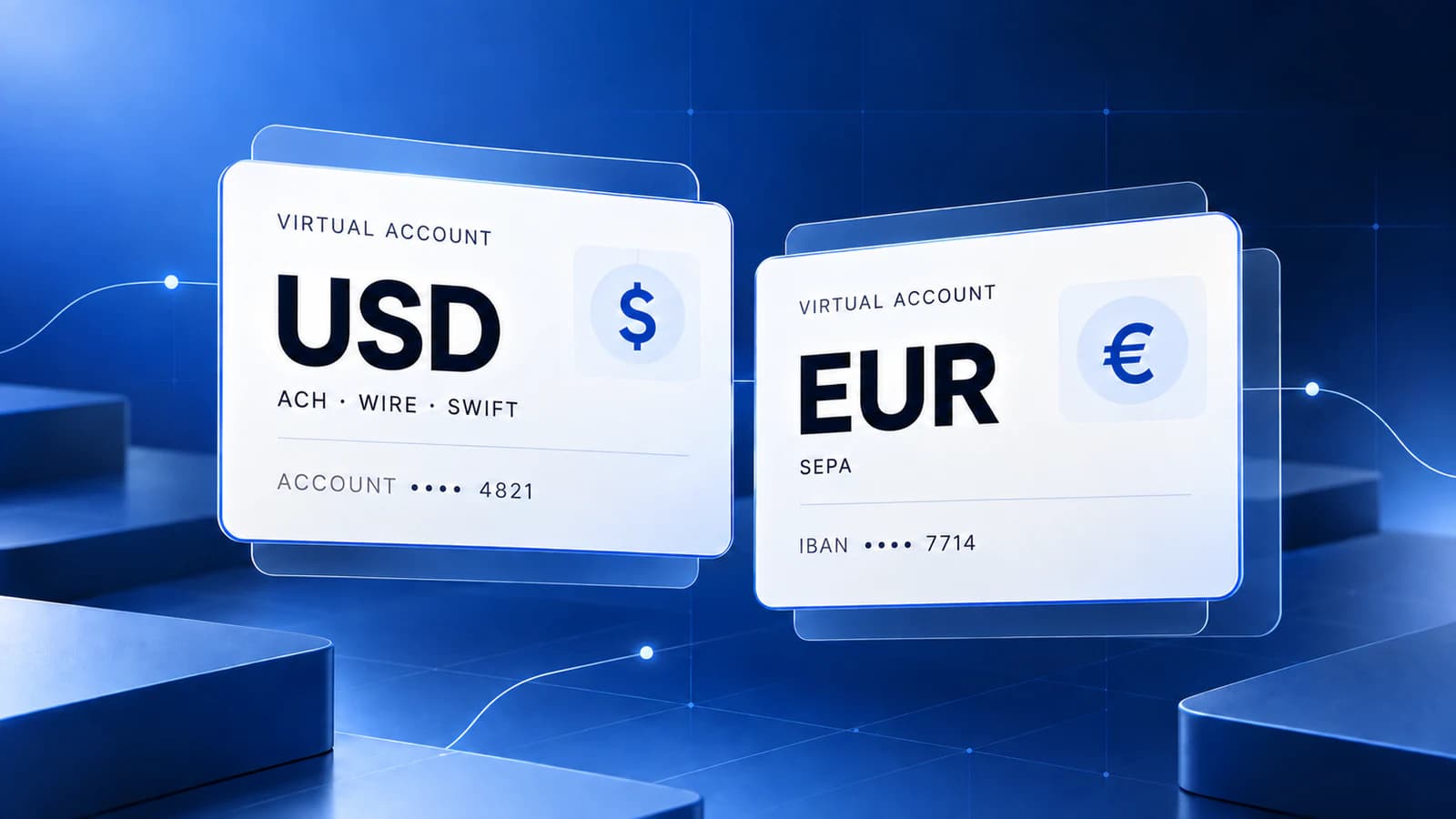
For USD, TroqPay supports receiving through ACH, Wire, or SWIFT. For EUR, it supports the SEPA network. Final availability depends on the products enabled for each operation.
Frequently asked questions about virtual accounts
Is a virtual account a bank account?
It is not the same as a traditional bank account. At TroqPay, a virtual account is presented as banking details dedicated to the business operation for receiving USD or EUR transfers. TroqPay is a financial technology company, not a bank.
Which currencies can I receive?
The current virtual account offering supports USD and EUR, according to the features enabled for the business.
Which transfer types are available?
For USD, TroqPay supports ACH, Wire, or SWIFT. For EUR, it supports transfers through the SEPA network.
Can I use a virtual account to charge customers through Pix?
That is a different flow. For local sales through Pix, TroqPay offers checkout, payment links, and API products. A virtual account is designed to receive USD or EUR transfers.
Do I need to open an account in every country?
A virtual account is designed to provide receiving details without requiring the business to build a new banking structure for each market. This does not remove eligibility reviews, documents, or other obligations related to the international operation.
What do I need to request a virtual account?
The business must complete and receive approval through TroqPay's KYB process. It can then request the account compatible with its operation.
Receive across markets without losing sight of the operation
A virtual account makes sense when it turns an international sale into a more organized collection flow. The value is not only in the banking details, but in the ability to track what came in and connect that information to the rest of the business.
Explore TroqPay virtual accounts and see how to receive USD or EUR as part of a more connected global operation.